
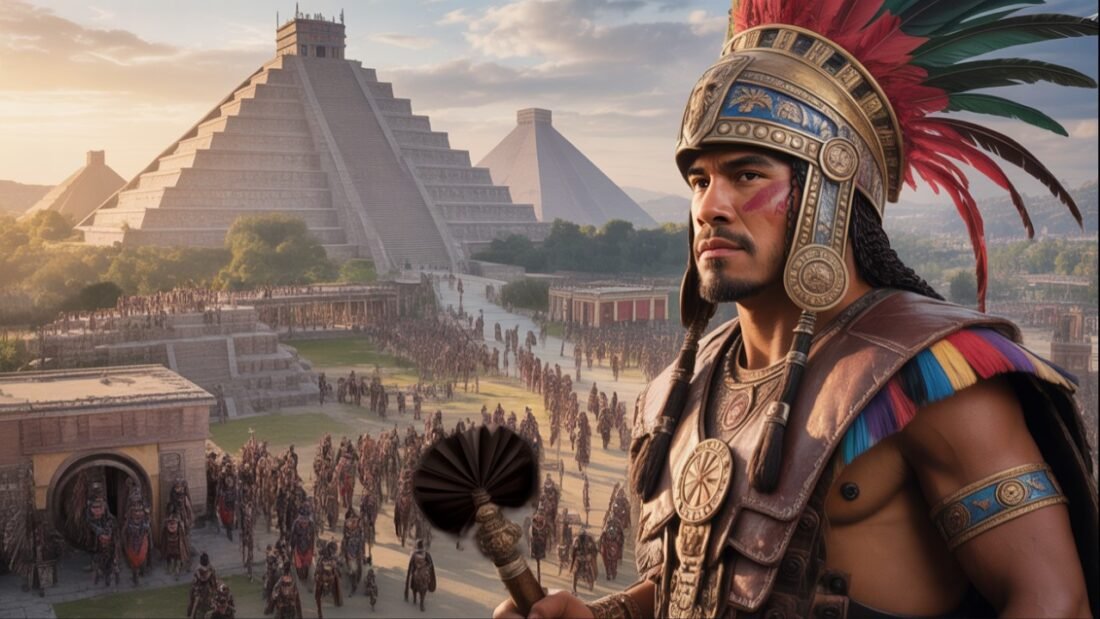
History often feels inevitable when we look backward—but it rarely is. In 1519–1521, the fall of the Aztec Empire hinged on a chain of fragile moments: alliances born of resentment, diseases carried unknowingly across oceans, and one desperate escape across a rain‑soaked causeway. Change just one of those moments, and the modern world begins to look radically different.
This article explores an alternate timeline inspired by our latest Global Whys video: What if Hernán Cortés had been defeated—and the Aztec Empire had survived?
A World on the Brink
On the eve of the Spanish arrival, the Mexica world was powerful but precarious. The Aztec Empire was not a single monolithic state, but a Triple Alliance linking Tenochtitlan, Texcoco, and Tlacopan. From its island capital—one of the largest and most advanced cities on Earth—the empire ruled millions through tribute, military dominance, and religious authority.
Yet this system bred enemies. Chief among them were the Tlaxcalans, long‑standing rivals locked in ritualized but deadly conflict with the Mexica. Their resentment would later become one of Cortés’ most decisive advantages.
When Cortés landed in 1519 with only a few hundred men, he did not conquer an empire by force alone. He exploited internal fractures, uncertainty at the highest levels of Aztec leadership, and—most devastating of all—disease.
The Night History Almost Ended Differently
Everything came to a head during La Noche Triste—the Night of Sorrows—on June 30, 1520. Trapped in a city in open revolt, weighed down by stolen gold, the Spanish attempted a nighttime escape across the causeways of Tenochtitlan.
In our timeline, a battered remnant survived.
In this alternate one, they do not.
The bridge collapses. The causeway becomes a killing ground. Cortés and his captains are captured or slain. By dawn, the Spanish expedition is annihilated, and the invaders from across the sea are revealed—not as gods, but as mortal men.
Survival Through Unity
Victory does not spare the Aztecs from catastrophe. Smallpox still sweeps through Mesoamerica, killing leaders and civilians alike. But without a foreign army laying siege to the capital, the state endures.
Under the young ruler Cuauhtémoc, the empire adapts. Instead of destroying Tlaxcala, the Mexica do something unprecedented: they offer alliance. From necessity, not mercy, a new political order emerges—a united Anahuac Confederacy, forged in response to the existential threat of Europe.
When Spain returns years later, it finds a coast prepared, an enemy informed, and a war it cannot win.
Adapting to a Dangerous World
Survival demands transformation. Over generations, the Confederacy studies European technology left behind on the battlefield. Steel weapons are reverse‑engineered. Gunpowder is experimented with. Horses—once terrifying symbols of Spanish power—become tools of a new Mesoamerican cavalry.
Political structures evolve, religion reforms, and sacrifice gradually shifts from mass ritual to symbolic practice. The empire does not become European—but it does become modern, on its own terms.
A Planet Rewritten
Without Mexican silver, Spain’s dominance in Europe falters. Other powers approach the Americas not as conquerors, but as negotiators. Tenochtitlan becomes a diplomatic and economic center of the Atlantic world.
Centuries later, the Anahuac Confederacy faces industrialization, global wars, and rising powers like the United States—not as a victim of history, but as one of its authors.
Nahuatl becomes a global language. Mesoamerican philosophy enters world discourse. The myth of European inevitability collapses.
History Is More Fragile Than We Think
The fall of the Aztec Empire was never guaranteed. It balanced on disease, chance, and a single chaotic night in 1520. Change that moment, and the modern world unravels into something entirely different.
This is the heart of alternate history—not fantasy, but possibility.
Watch the full video on Global Whys and tell us: which single moment in history do you think could have changed everything?
When the Aztecs Won: A Completely Different World
00:00 – Tenochtitlan
03:45 – The Point of Divergence
07:04 – A New Timeline Unfolds: Part 1
10:34 – A New Timeline Unfolds: Part 2
14:31 – A New Timeline Unfolds: Part 3
16:42 – Conclusion
🔗 Facebook: https://www.facebook.com/GlobalWhys
🔗 Blog: https://globalwhys.com
#GlobalWhys #history #alternatehistory #aztecsShow More




Leave a Reply