
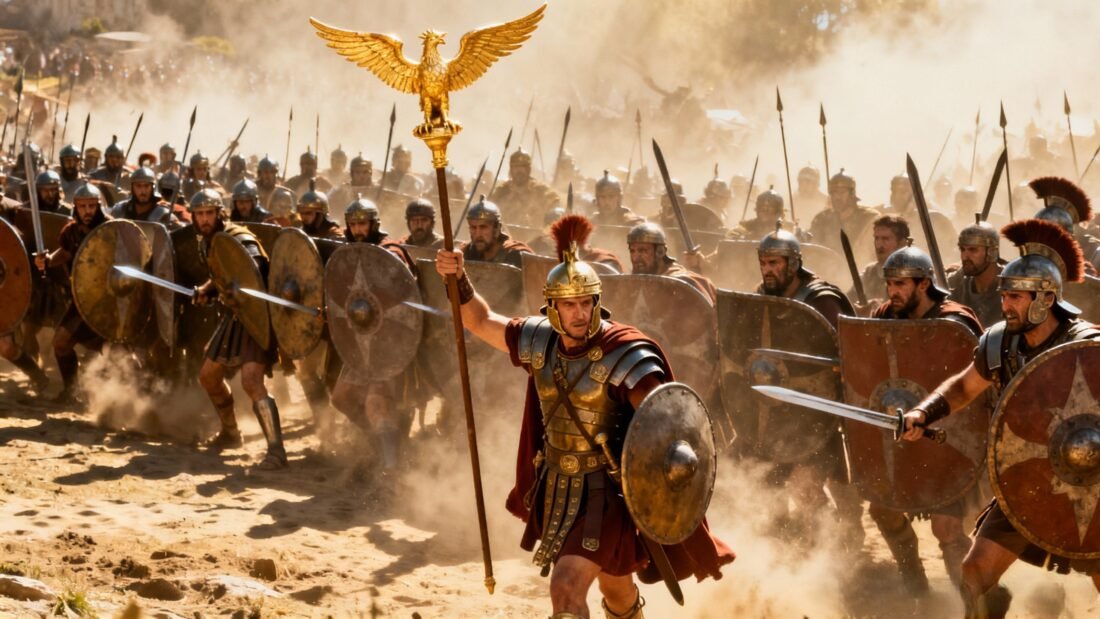
For nearly two thousand years, a single question has cast a long shadow over Roman history: What happened to the Ninth Legion? Known as Legio IX Hispana, these soldiers once marched beneath the Aquila of Rome’s power—battle-hardened veterans forged under Julius Caesar himself. And then, sometime after 108 AD, they simply vanished.
No final battle recorded.
No official disbanding.
No surviving account of their last campaign.
Just silence.
In this investigation, we dive deep into ancient sources, archaeological finds, and modern theories to unravel what may have been the Ninth’s true fate. From bloody revolts in Britain to the brutal frontiers of the Rhine and the chaotic battlefields of the East, this mystery spans the entire Roman Empire.
A Legion With a Legendary Past
The Ninth wasn’t just another unit. It was an institution with centuries of history.
It fought under Caesar in Gaul, earned the honorific Hispana during Augustus’s campaigns in Spain, and helped spearhead the Roman invasion of Britain in 43 AD.
For decades, they served as the backbone of Rome’s control over the island, building forts, enforcing imperial rule, and guarding the dangerous northern frontier from tribal resistance.
The Blow That Nearly Destroyed Them
In AD 60/61, the Ninth faced its darkest hour.
When Boudicca, queen of the Iceni, launched her uprising, the Ninth marched south to stop the rebellion—but they were ambushed and overwhelmed. Tacitus records that nearly the entire infantry force was wiped out. Only the commander and the cavalry escaped.
Rebuilt with reinforcements from Germany, the Ninth recovered and continued serving on the frontier. But this near-annihilation would haunt their legacy.
108 AD: The Last Confirmed Trace
The final definitive record of the Ninth in Britain comes from a stone inscription found in York. Dated precisely to 108 AD, it commemorates the reconstruction of a fortress gate by Legio IX Hispana.
After this — nothing.
When Emperor Hadrian visited Britain in 122 AD, a different legion had taken the Ninth’s place. Not a single inscription anywhere in Britain mentions them again.
It’s as if they simply disappeared.
So What Happened? The 3 Leading Theories
Historians are divided into three major camps.
1️⃣ Annihilated in Scotland
The most popular version—fueled by fiction, film, and centuries of imagination—is that the Ninth marched north into Caledonia and was wiped out by tribes.
It’s dramatic.
It’s cinematic.
It’s the basis for The Eagle of the Ninth.
The problem?
There is zero archaeological evidence of a destroyed legion—no battlefield, no mass grave, no legionary eagle.
For many scholars, this theory is more legend than fact.
2️⃣ Transferred to the Continent — and Quietly Disbanded
Archaeology provides a compelling alternative.
Tiles and artifacts stamped with “Legio IX Hispana” have been found at Nijmegen (Netherlands) and dated after 108 AD. Senior officers from the Ninth are also recorded as having successful careers long after their supposed disappearance.
This suggests the legion was not destroyed, but transferred out of Britain.
From there, they may have:
- suffered heavy losses on the Rhine/Danube frontiers
- declined through attrition
- been quietly disbanded as a bureaucratic decision
Not glamorous — but highly plausible.
3️⃣ Destroyed in the East
If the Ninth was moved out of Britain, it might have ended up in:
- The Bar-Kokhba Revolt (132–136 AD) — a brutal war in Judea where another legion (XXII Deiotariana) did disappear from the record.
OR - The Parthian War (161–166 AD) — where an unnamed Roman legion was ambushed and annihilated at Elegeia.
Either event could explain the Ninth’s disappearance — but there is no direct evidence placing them in the East.
The Verdict: A Mystery That Refuses to Die
After weighing all the evidence:
- A Scottish annihilation is unlikely
- A continental transfer is well supported
- A final destruction in the East is possible but unproven
The most probable scenario?
A legion transferred from Britain, weakened in frontier warfare, and eventually dissolved into the vast machinery of Rome’s military system — its final moments lost to history.
And perhaps that’s why the Ninth remains so captivating.
Not because we know their fate… but because we don’t.
Watch the Full Investigation
If you want the complete detective story—from Caesar’s battlefields to the edge of Hadrian’s Wall—watch the full video here:
The Mystery of the Missing Ninth Legion!
CHAPTERS:
00:00 – Legio IX Hispana
01:03 – The Legend of the Ninth
03:23 – The Setback – Boudicca’s Fury
05:54 – The Vanishing Point
08:48 – Theory 1 – Annihilation in Caledonia
11:28 – Theory 2 – Transfer to the Continent and the “Rhine-Danube” Solution
13:52 – Theory 3 – Destruction in the East
16:25 – Conclusion: The Verdict – An Enduring Mystery
🔗 Facebook: https://www.facebook.com/GlobalWhys
🔗 Blog: https://globalwhys.com
#GlobalWhys #history #romanhistoryShow More
Join the Investigation
Which theory do you find most convincing?
Tell us your verdict in the comments — and subscribe for more mysteries of history, empire, and the ancient world.




Leave a Reply