
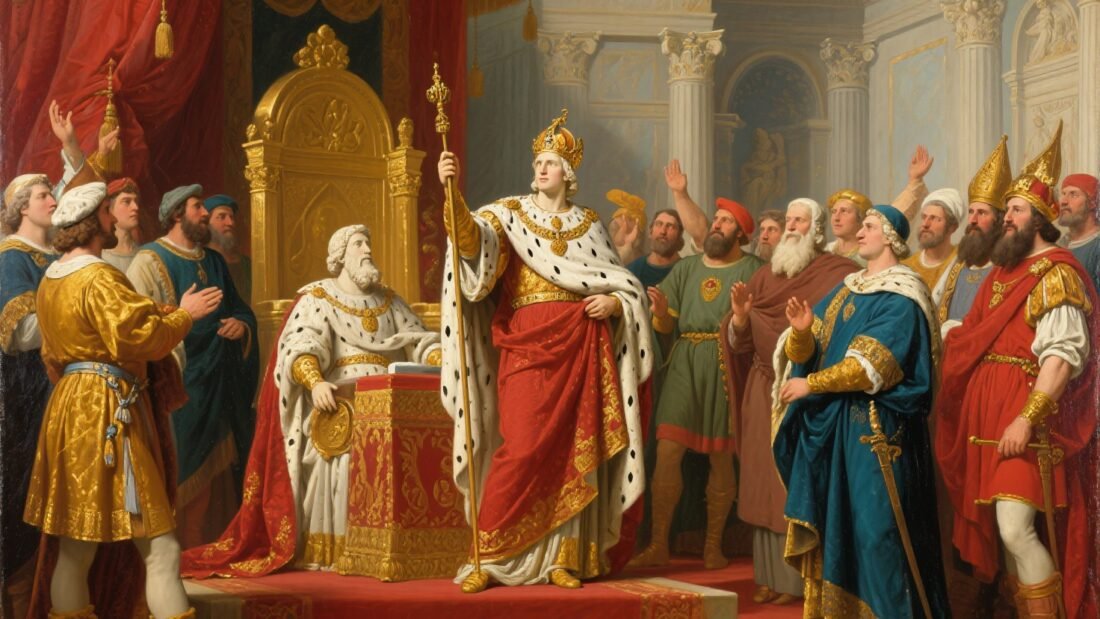
When people picture medieval Europe, they often think of castles, knights, and kings — a world ruled by crowns and banners. But how did Europe go from the fall of the Roman Empire to a continent full of monarchies in just 1,000 years?
It sounds impossible, but the transformation from chaos to kingdoms was one of the fastest political shifts in human history.
The Fall That Started It All
Our story begins in 476 CE, when the Western Roman Empire finally collapsed. The last emperor, Romulus Augustulus, was deposed by a Germanic general named Odoacer, and the once-mighty empire of Rome fractured into dozens of territories.
Roads crumbled, cities emptied, and literacy nearly vanished. For a while, Europe seemed lost in the dark.
But chaos didn’t last forever. Local warlords began filling the power vacuum, declaring themselves kings of their lands — and the first medieval monarchies were born.
The Rise of Early Kings
By the late 400s, powerful leaders were carving new kingdoms out of the ruins of Rome. Among the most important were Theodoric the Great in Italy, Clovis I of the Franks, Alaric II of the Visigoths, and Childebert I of the Merovingian dynasty.
These early kings laid the groundwork for medieval Europe. They weren’t just warriors — they were administrators, lawgivers, and founders of dynasties that would shape the continent for centuries.
And while men dominated medieval politics, a few powerful women — like Queen Brunhild of Austrasia — defied tradition and ruled in their own right, even if history tried to forget them.
The Carolingian Renaissance: Charlemagne’s Empire
Then came Charlemagne, the king who would change everything.
Ruling from 768 to 814, Charlemagne united vast parts of Western Europe and revived learning, art, and administration in what historians call the Carolingian Renaissance. On Christmas Day in the year 800, he was crowned Holy Roman Emperor by the Pope — a symbolic rebirth of Rome under Christian kingship.
But after his death, the empire splintered. The Treaty of Verdun (843 CE) divided his lands into three parts — early versions of modern France, Germany, and Italy. This division weakened unity but solidified the idea that kings ruled by divine right — not just by force.
Vikings, Nobles, and New Kingdoms
As Europe’s kings fought each other, a new wave of invaders appeared — the Vikings.
From the late 700s onward, Norse raiders swept across the continent, looting monasteries and founding settlements from Ireland to Constantinople. Some, like Rollo, even traded their swords for titles — he received Normandy from the King of France in 911, creating one of the most influential duchies in Europe.
Meanwhile, kings like Cnut the Great built empires that connected England, Denmark, and Norway under one crown. Yet the true power often shifted to local nobles, who ruled their territories independently and laid the foundations of feudalism.
The Church, The Crown, and The Crusades
As the centuries passed, religion and politics became inseparable. The Investiture Controversy of the 11th century — a power struggle between the Pope and Emperor Henry IV — defined who truly ruled Christendom: the Church or the Crown.
The result was a new balance of power that paved the way for the High Middle Ages — a time of crusades, universities, and intellectual revival. From Oxford to Bologna, education began to flourish again, though it remained a privilege of the elite.
England’s Turning Point: The Magna Carta
In 1215, the English barons forced King John to sign the Magna Carta, a groundbreaking document that limited royal power and recognized the rights of subjects. It was the beginning of constitutional governance — and a reminder that even kings could be held accountable.
While the rest of Europe continued to wage wars and crusades, England’s unique political evolution gave rise to a culture of law and liberty that still echoes today.
Plagues and the Rise of Modern Europe
By the mid-1300s, Europe was struck by the Black Death, a plague that killed millions and shattered the old feudal order. Labor shortages gave commoners new leverage, cities grew, and kings consolidated power over weakened nobles.
The age of medieval kings was ending — but their legacy shaped the modern nation-states that would soon dominate the world.
A Thousand Years in Fast Forward
In just a millennium, Europe transformed from the ashes of Rome into a continent of crowns, castles, and emerging nations. Kings rose and fell, empires expanded and crumbled, but one truth endured: the quest for power never stopped.
History, after all, is the story of who wears the crown — and who takes it next.
🎥 Watch the full video on YouTube:
Why Did Medieval Europe Fall Under King's Control So Quickly?
——————————————–
➡️ Step into the throne room with Crusader Kings III: https://www.g2a.com/n/crusader-kings-3-globalwhys
➡️ Want to conquer medieval Europe? Get Royal Court Europe: https://www.g2a.com/n/crusader-kings-3-royal-court-globalwhys
——————————————–
Affiliate Disclosure: Some of the links in this description may be affiliate links. This means that if you click on them and make a purchase, I may earn a small commission at no extra cost to you. Thank you for supporting the channel!
OTHER LINKS:
🔗 Facebook: https://www.facebook.com/GlobalWhys
🔗 Blog: https://globalwhys.comShow More
Frequently Asked Questions
Who was the first medieval king in Europe?
The title of the first medieval king is often given to Clovis I, who became King of the Franks in 481 CE. He united several Frankish tribes under one rule and converted to Christianity, setting a precedent for later European monarchs who tied royal power to religion.
How did the fall of Rome lead to the rise of kings?
When the Western Roman Empire collapsed in 476 CE, its centralized government disappeared.
Local warlords and tribal leaders began to rule over smaller regions, declaring themselves kings to gain legitimacy. Over time, these territories evolved into the early medieval kingdoms that became modern European nations.
What was Charlemagne’s role in shaping medieval Europe?
Charlemagne, or Charles the Great, united much of Western Europe during the late 700s. He encouraged education, established administrative reforms, and revived culture in what became known as the Carolingian Renaissance. His coronation as Holy Roman Emperor in 800 CE symbolized the rebirth of imperial rule in Europe.
What event marked the end of the Middle Ages?
Historians debate the exact end, but most agree it came around the 15th century, marked by events like the fall of Constantinople (1453), the invention of the printing press, and the Age of Discovery. These changes signaled the transition from the medieval world to the Renaissance and the beginning of modern Europe.



Leave a Reply