
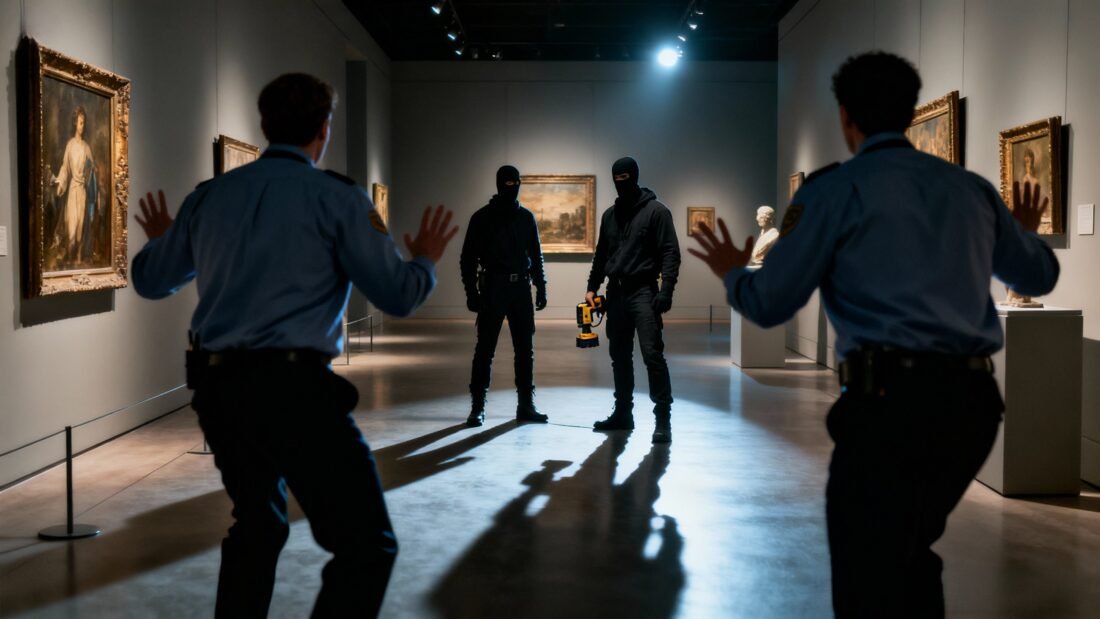
On the morning of October 19th, 2025, Paris woke up to what would soon be called the most audacious museum heist of the 21st century.
Inside the Louvre — the most visited museum on Earth — visitors admired masterpieces under vaulted ceilings, unaware that history itself was being stolen just meters away.
At 9:30 AM, alarms shattered the calm inside the Galerie d’Apollon. Security guards rushed in… and found empty display cases, shattered glass, and a silence that would soon echo across the world.
In less than eight minutes, four helmeted thieves had breached the heart of the Louvre and vanished with eight priceless jewels worth an estimated €88 million.
But money was never the real prize.
Because what they stole — and what they deliberately left behind — revealed something far more disturbing.
This was not a theft of jewels. It was the theft of a story — one that leads straight back to Napoleon Bonaparte.
🎬 Watch the Full Video
The Most Daring Heist in Paris: The Louvre Jewel Theft
00:00 – The Heist at the Louvre
01:16 – The Crime of the Century
03:55 – The First Clue: An Imperial Thread
06:02 – A Love Forged in Empire: The Emerald Parure
08:21 – The Sapphire Legacy: From an Empress to a Queen
09:59 – Echoes of the Second Empire: The Jewels of Eugénie
11:53 – Connecting the Centuries
13:44 – The Lingering Mystery
15:23 – Conclusion
🔗 Facebook: https://www.facebook.com/GlobalWhys
🔗 Blog: https://globalwhys.comShow More
(Highly recommended with sound and full screen.)
A Heist Unlike Any Other
The operation was executed with terrifying precision.
Disguised as construction workers, the thieves used a furniture lift to access a second-floor window. Inside the gallery, they sliced through reinforced glass using power tools — ignoring jewels that, by raw value, were far more lucrative.
They left behind:
- The Regent Diamond (140 carats)
- The Sancy Diamond
- The Hortensia Diamond
Instead, they selected eight very specific pieces, spending only four minutes inside the gallery.
That choice changed everything.
Because those jewels weren’t random.
They were connected by a single imperial thread — one that spanned two empires, a fallen dynasty, and the women who shaped Napoleon’s world.
The Imperial Thread: Why These Jewels Mattered
As investigators and historians examined what was taken, a chilling realization emerged. The thieves had curated their loot like museum experts.
The missing jewels formed a perfectly coherent historical collection — pieces commissioned by Napoleon Bonaparte, inherited by his empresses, and passed through the royal families that followed him.
This was a connoisseur’s crime.
The leading theory? A theft by order, commissioned by a private collector obsessed not with wealth — but with Napoleonic history.
To understand why, we have to go back more than 200 years.
Napoleon’s Marriage of Power — The Emerald Parure
In 1810, Napoleon ruled Europe — but lacked an heir.
With brutal pragmatism, he divorced Joséphine, the love of his life, and married Marie-Louise of Austria, daughter of his former enemy, the Habsburg Emperor.
To mark the union, Napoleon commissioned an extraordinary jewel set: the Emerald and Diamond Parure.
The stolen necklace and earrings — composed of 32 Colombian emeralds and over 1,100 diamonds — were part of that very set.
They were not decorations. They were political statements, symbols of a new empire meant to rival all others.
When Napoleon fell, Marie-Louise escaped Paris — and managed to keep the parure as personal property. The jewels vanished into private hands, surviving revolutions, exile, and dynastic collapse.
Until they surfaced again… behind glass at the Louvre.
Until 2025.
From Empress to Queen: The Sapphire Legacy
The thieves also targeted a sapphire parure tied to Joséphine’s daughter, Hortense, and later to Queen Marie-Amélie, wife of the king who replaced Napoleon’s dynasty.
These jewels witnessed:
- The rise of the Bonapartes
- Their fall
- And the transfer of power to a rival royal house
Stealing them wasn’t about gemstones.
It was about capturing a moment where history turned.
The Ghost of Empire: Empress Eugénie’s Jewels
The final pieces came from the glittering court of Napoleon III and Empress Eugénie.
Among the stolen items:
- A pearl and diamond tiara
- A massive corsage bow brooch worn to receive Queen Victoria
- A reliquary brooch containing a hidden holy relic
But the most powerful image came from the jewel they failed to steal.
Eugénie’s Imperial Crown — damaged and abandoned inside the gallery — became the haunting symbol of the heist.
An empire’s crown, once again brought low.
The Missing Mastermind
French police arrested all four suspects within weeks. DNA evidence was conclusive. And yet — the jewels are gone.
As of January 2026, none have appeared on the black market. No stones re-cut. No settings dismantled.
Which only strengthens the most unsettling theory of all: The jewels were stolen for one person — and will never be seen again. A collector wealthy enough to buy silence. Obsessed enough to steal history itself.
Why This Story Matters
The 2025 Louvre Heist wasn’t just a crime. It was a reminder that historical objects are not passive artifacts. They carry ambition, love, betrayal, and power — and those stories still exert a pull strong enough to drive modern crime.
Someone believed so deeply in that power, they orchestrated the crime of the century to possess it.
Discover More Hidden Histories with Global Whys
At Global Whys, we explore the forgotten connections, strange decisions, and untold stories that shaped our world.
If you enjoy history told as mystery —
If you believe the past still has secrets worth uncovering —
👉 Subscribe to Global Whys on YouTube
👉 Watch the full video above
👉 Join us as we ask the questions history never answers outright 👇
Because sometimes, the most valuable thing ever stolen…
is the story itself.
Frequently Asked Questions (FAQ)
What was stolen in the 2025 Louvre jewel heist?
In the October 19th, 2025 Louvre heist, thieves stole eight historically significant jewels linked to the Napoleonic era. These included an emerald necklace and earrings commissioned by Napoleon for Empress Marie-Louise, a sapphire tiara and necklace tied to Joséphine’s family, and several jewels belonging to Empress Eugénie. The total estimated value was €88 million.
Why didn’t the thieves steal the most valuable diamonds in the Louvre?
The thieves deliberately ignored more valuable gemstones like the Regent Diamond, Sancy Diamond, and Hortensia Diamond. Investigators believe this was a targeted, narrative-driven theft, focused on jewels connected specifically to Napoleon Bonaparte and his dynasty, not raw monetary value.
Is the Louvre jewel heist connected to Napoleon Bonaparte?
Indirectly, yes. The stolen jewels were all personally commissioned by Napoleon or passed down through his empresses and royal descendants. The heist appears to have been motivated by a fascination with Napoleon’s legacy rather than simple financial gain.
Were the Louvre jewel thieves caught?
Yes. By November 2025, French police had arrested all four suspected thieves, using DNA evidence recovered from a helmet left at the scene. However, the stolen jewels have not been recovered, and investigators believe the arrested men were hired operatives rather than the mastermind behind the crime.
Where are the stolen Napoleonic jewels now?
As of January 2026, the jewels have not appeared on any known black market or auction networks. Authorities believe they may be hidden in a private collection, possibly commissioned by a wealthy collector obsessed with Napoleonic history.
Could the stolen jewels be destroyed or dismantled?
While possible, experts believe this is unlikely. A criminal interested only in materials would have taken larger, purer stones. The selective nature of the heist suggests the jewels were stolen for their historical integrity, not to be melted down or re-cut.
Why is the 2025 Louvre heist considered unique?
Unlike typical art thefts driven by profit, this heist focused on a curated historical narrative. The thieves stole objects that together tell the complete story of the Napoleonic dynasty, making it one of the rare cases where history itself was the primary target.
Will the stolen Louvre jewels ever be returned?
Art crime experts are pessimistic. If the jewels were stolen for a private collector, they may remain hidden for decades, only resurfacing through inheritance disputes, leaks, or political changes — as has happened with other legendary art thefts.




Leave a Reply