
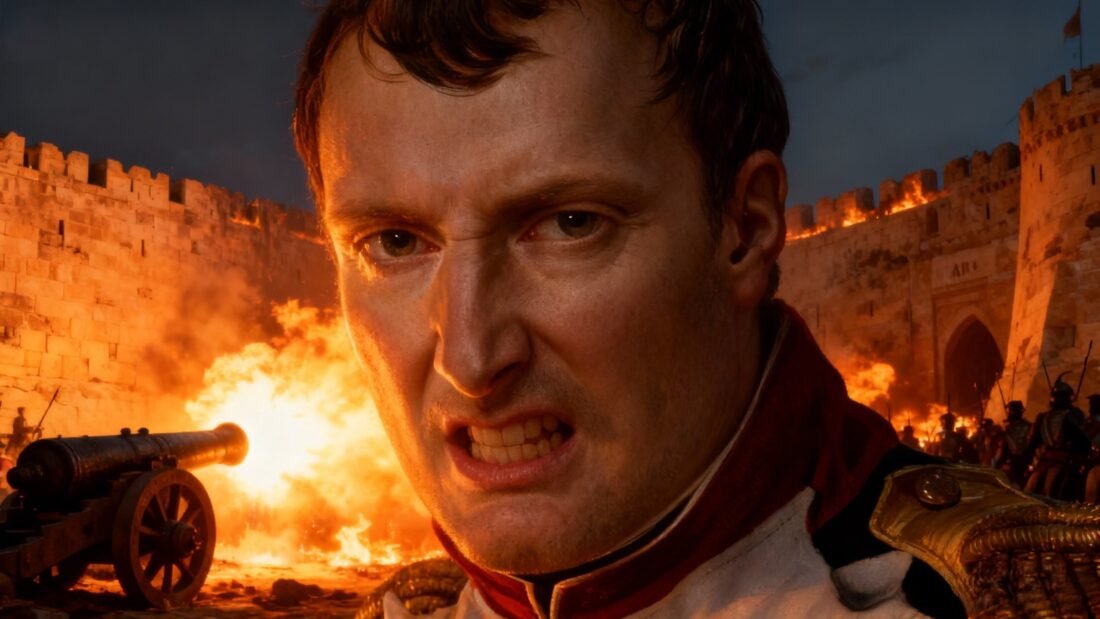
History remembers Napoleon Bonaparte as a force of nature — a man who crushed empires, humbled kings, and bent Europe to his will. His story is usually told through famous rivals: Wellington at Waterloo, Nelson at sea, or the frozen vastness of Russia.
But what if the man Napoleon later claimed “made me miss my destiny” wasn’t an emperor or a legendary general?
What if it was a British naval officer, largely forgotten by history — a man who repeatedly appeared at the worst possible moments and quietly shattered Napoleon’s greatest ambitions?
This is the story of Sir Sidney Smith — Napoleon’s most infuriating, unsung nemesis.
🎬 Watch the Full Video: Why Did Napoleon Fear This One Man?
Why Did Napoleon Fear This One Man?
00:00 – Sir Sidney Smith
01:39 – The Corsican Comet
04:12 – The Cavalier of the Seas
05:52 – The First Clash: The Inferno at Toulon
08:02 – The Prisoner and the Ghost
09:48 – The Dream of the East
11:40 – The Siege of Acre: The Unmovable Object
14:43 – The Aftermath: “That Man Made Me Miss My Destiny”
17:10 – Conclusion
🔗 Facebook: https://www.facebook.com/GlobalWhys
🔗 Blog: https://globalwhys.com
#GlobalWhys #history #napoleonShow More
(Best experienced with sound on.)
A Rivalry History Almost Forgot
History is written by the victors — and by the loudest names. Napoleon’s era is usually framed as a clash of titans, but history also unfolds in shadows, footnotes, and personal grudges.
Napoleon, a man who redrew the map of Europe, harbored a unique animosity toward someone most people have never heard of.
Not a monarch.
Not a duke.
But a swashbuckling British naval officer, infamous for improvisation, audacity, and a talent for ruining grand plans.
Sir Sidney Smith didn’t defeat Napoleon once.
He stopped him twice — at two critical turning points.
Toulon: Where the Legend Began… and Was Scarred
In 1793, France was in chaos. Revolution had torn down the old order, and foreign powers rushed in to crush the new Republic. The crisis reached a breaking point at Toulon, France’s most important Mediterranean naval base.
A young, unknown artillery officer named Napoleon Bonaparte proposed a bold plan: control the heights overlooking the harbor — and force the British fleet to flee or burn.
The plan worked brilliantly.
Napoleon’s cannons made the harbor untenable. The British were forced to evacuate. His victory at Toulon launched his meteoric rise.
But as he watched from the heights he had conquered, something horrifying unfolded below.
A British officer had slipped into the harbor under cover of darkness.
His name was Sir Sidney Smith.
Smith ignited the French fleet and naval stores in a catastrophic inferno — destroying the very prize Napoleon had fought to reclaim. It was a spectacular act of defiance… and humiliation.
Napoleon had won — yet watched his victory burn.
He made a point of learning the man’s name.
The Prisoner Who Became a Ghost
Smith didn’t stop.
He harassed the French coast relentlessly until, in 1796, he was finally captured and imprisoned in Paris’s notorious Temple Prison. The French believed the problem was solved.
They were wrong.
With forged orders, disguises, and help from French royalists, Smith simply walked out the front gate of the prison — escaping France entirely.
The man Napoleon thought was caged had vanished.
And he would return at the worst possible time.
Acre: Where an Emperor’s Dream Died
By 1799, Napoleon was unstoppable. After conquering Italy, he launched a bold eastern campaign, dreaming of rivaling Alexander the Great.
Egypt fell.
The pyramids echoed with victory.
But disaster followed. Nelson destroyed the French fleet, trapping Napoleon’s army in the East. With no retreat possible, Napoleon pushed north into Ottoman Syria.
One city stood in his way: Acre.
Napoleon expected it to fall within weeks.
Waiting for him behind its walls… was Sir Sidney Smith.
Smith intercepted Napoleon’s siege artillery at sea — then mounted those very cannons on Acre’s walls, turning them back on the French. British ships pounded French positions relentlessly. Smith landed sailors and marines to reinforce the defense. Psychological warfare followed.
For two brutal months, Napoleon attacked — and failed.
On May 20, 1799, Napoleon ordered the retreat.
His eastern dream was over.
“That Man Made Me Miss My Destiny”
Years later, exiled on St. Helena, Napoleon reflected on his defeat. He reportedly blamed one man above all others:
Sir Sidney Smith.
Had Acre fallen, Napoleon believed he could have marched on Constantinople, crowned himself emperor of the East, and returned to Europe as a legend beyond comparison.
Whether true or not, Napoleon believed it.
And that belief gave birth to his bitter lament:
“That man made me miss my destiny.”
Why Sir Sidney Smith Matters
Sidney Smith never became as famous as Nelson.
His flamboyance annoyed the British Admiralty.
History reduced him to a footnote.
Yet twice — at Toulon and Acre — he altered the trajectory of one of history’s greatest figures.
He proved something deeply uncomfortable:
Even the greatest conquerors can be stopped — not by empires, but by individuals.
Explore More Forgotten Stories with Global Whys
This story is exactly why Global Whys exists — to uncover the overlooked moments, hidden rivalries, and forgotten figures that quietly shaped our world.
If you enjoy cinematic, curiosity-driven history that goes beyond textbooks:
👉 Subscribe to Global Whys on YouTube
👉 Watch the full video above
👉 Join us as we explore the “why” behind history’s greatest mysteries
Because sometimes, history doesn’t turn on armies —
but on one stubborn man who refuses to step aside.


Leave a Reply