
In 1921, Tulsa’s Greenwood District stood as one of the most extraordinary success stories in American history. A thriving, self-sufficient Black community—so prosperous it was called Black Wall Street. Doctors, lawyers, entrepreneurs, educators… all building a city within a city.
Then, in less than 24 hours, it was gone. Burned to the ground by white mobs. Erased from history books for over 70 years. What happened in Tulsa was not a “riot.” It was an invasion. A massacre. And it’s one of the most shocking examples of how hate, fear, and lies can destroy not just lives—but an entire world.
The Invasion of Greenwood
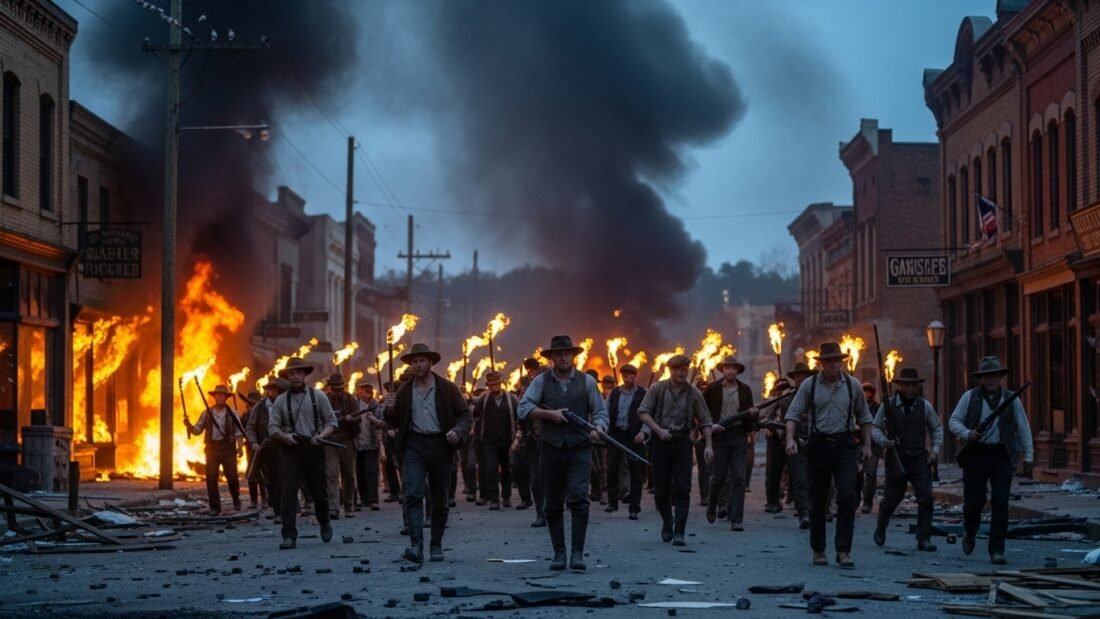
As night fell on May 31, 1921, Greenwood’s defenders—residents protecting their homes—were pushed back across the railroad tracks. On the other side, a white mob had transformed into an armed force.
Some were even deputized by Tulsa police, handed weapons, and told to “get a gun and get a n*****”. They broke into armories and hardware stores, looting weapons and ammunition. Then, like an invading army, they stormed Greenwood.
At first, they looted—smashing windows, stealing goods. But soon, the violence turned genocidal. They set fire to homes, shot residents fleeing into the streets, and murdered people as they slept.
Greenwood’s men and women fought back heroically, defending their families and their livelihoods, but they were hopelessly outnumbered. City authorities, instead of stopping the mob, supplied it.
Fire from the Sky
At dawn on June 1st, 1921, the horror reached new heights. Witnesses described airplanes flying low over Greenwood, dropping incendiary bombs and shooting at fleeing residents.
This was one of the first aerial attacks on American soil—decades before Pearl Harbor.
Firefighters who tried to help were turned away or threatened at gunpoint. The Dreamland Theatre, the Stradford Hotel, the hospital, and hundreds of businesses were engulfed in flames.
The smoke was so thick it blotted out the sun. In a matter of hours, Black Wall Street—a symbol of Black achievement—was reduced to ash.
The Human Toll
Over 1,200 homes destroyed. As many as 300 people killed. Thousands left homeless and rounded up into internment camps—held at gunpoint by the same forces that had failed to protect them.
Doctors, teachers, mothers, and children—all victims of a lie that started in an elevator and ended in a firestorm.
One of the most respected Black doctors in the nation, Dr. A.C. Jackson, surrendered peacefully and was shot dead in his yard.
By noon, Greenwood was gone.
The Cover-Up and the Betrayal of Justice
When the fires went out, the lies began. City officials and newspapers called it a “race riot”—a term that both hid the truth and voided all insurance claims.
Not a single white perpetrator was charged. Every lawsuit filed by survivors was dismissed. The city even passed new fire ordinances to make rebuilding nearly impossible.
A century later, the story repeated. In 2024, the Oklahoma Supreme Court dismissed the lawsuit brought by the last two living survivors—Viola Fletcher and Lessie Benningfield Randle, both over 109 years old. Their fight for reparations was denied. Again.
The Unbreakable Spirit of Greenwood
And yet—out of the ashes, Greenwood rose again.
Led by attorney B.C. Franklin, survivors fought the discriminatory laws and rebuilt their homes and businesses from scratch. Living in tents, they reopened stores, schools, and restaurants.
By 1925, just four years later, the district was thriving once more—with even more businesses than before the massacre.
It was a miracle of resilience and community. A defiance of history itself.
The Second Destruction: Urban Renewal
But Greenwood would face one final betrayal. In the 1960s, the city of Tulsa routed Interstate 244 right through the heart of the rebuilt district—destroying homes and businesses once again.
This time, it wasn’t bombs or mobs. It was “urban planning”. And alongside the bulldozers came silence.
For most of the 20th century, the Tulsa Massacre was erased from history. It wasn’t taught in schools. It wasn’t mentioned in newspapers. Generations grew up never hearing about Black Wall Street at all.
Rediscovery and Legacy
It wasn’t until 1997 that the state of Oklahoma finally launched an investigation. Today, the Greenwood Rising history center stands on the site, preserving the memory that so many tried to erase.
The story of Greenwood isn’t just about tragedy. It’s about rebirth, strength, and the power of memory. It’s a story that asks us: How many other truths have been buried the same way?
Why This Story Matters
The destruction of Black Wall Street shows how fragile justice can be—and how easily hate can be weaponized. But it also proves that even in the face of annihilation, the human spirit can rebuild, resist, and rise again.
Remembering Greenwood isn’t about reliving pain—it’s about honoring strength. It’s about ensuring that when history tries to erase, we write it back in bold.
📢 Share This Story
The Tulsa Massacre was hidden for nearly a century. Its rediscovery is thanks to survivors who refused silence.
If you believe history deserves to be remembered, share this post with someone you know. And if you want to uncover more hidden histories that shape our world, subscribe to Global Whys—where forgotten truths come to light.
🧩 Watch the full documentary on YouTube:
The Tulsa Race Massacre: A City Destroyed, A History Buried
In 1921, Tulsa’s Greenwood District was so prosperous it was called “Black Wall Street.” Then white mobs, supported by local government, burned 35 city blocks to the ground, killing hundreds. The kicker? It was erased from textbooks for 70+ years.
CHAPTERS:
00:00 – Tulsa 1921
01:16 – The Genesis of a Dream
02:53 – Building the Mecca
04:54 – A Self-Sufficient World
06:31 – The Elevator Incident
07:49 – The Lie Takes Flight
08:46 – The Gathering Storm
10:02 – The First Shots
10:47 – The Invasion of Greenwood
11:49 – The Fire from the Sky
13:14 – The Human Toll
14:34 – A City in Ashes
15:45 – The Betrayal of Justice
16:54 – The Unbreakable Spirit of Rebirth
18:05 – The Slow Decline and Historical Erasure
20:01 – Conclusion
OTHER LINKS:
🔗 Facebook: https://www.facebook.com/GlobalWhys
🔗 Blog: https://globalwhys.com
SOURCES:
– Tulsa Race Massacre Commission Report (2001)
– Survivor testimonies archived at the Greenwood Cultural Center
– U.S. Congressional Records and modern historical analyses
#history #GlobalWhys #tulsamassacreShow More
Sources:
- Tulsa Race Massacre Commission Report (2001)
- Survivor testimonies archived at the Greenwood Cultural Center
- U.S. Congressional Records and modern historical analyses


Leave a Reply