
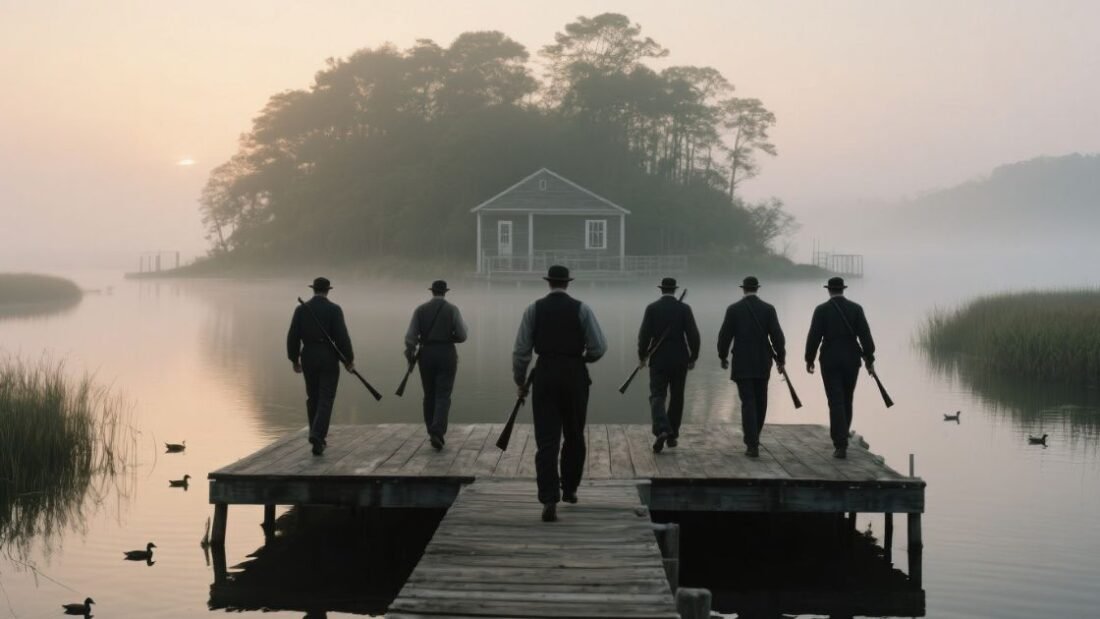
What if one of the most powerful institutions in the world — the one that controls interest rates, inflation, and the value of your money — was born in total secrecy? It sounds like a conspiracy theory, but in 1910, it actually happened. A handful of powerful financiers met on a private island off the coast of Georgia under the pretense of a duck hunting trip. Their mission: to design a new banking system for America. What they created on Jekyll Island would become the foundation of the Federal Reserve — a system that still governs global finance today.
The Panic That Started It All
By the early 1900s, America’s booming economy was a fragile mess of thousands of independent banks. With no central authority or emergency lender, financial panics were inevitable. The worst came in 1907, when the Knickerbocker Trust collapse triggered mass hysteria. With the government powerless, one man — J.P. Morgan — single-handedly rescued the U.S. financial system by forcing New York bankers to pool their resources. But it was clear this was no long-term solution. America couldn’t depend on one aging financier to save the nation.
The Secret Meeting on Jekyll Island
Senator Nelson Aldrich, head of the National Monetary Commission, knew the U.S. needed reform. But the words “central bank” were political poison. So Aldrich gathered a secret group of bankers and economists — including Frank Vanderlip, Henry Davison, and Paul Warburg — and took them to a private island owned by America’s richest families. For nine days, they worked in complete secrecy, drafting a plan to stabilize the economy and prevent future panics. Their cover story? A duck hunting trip. Their true goal? To design the future of American money.
Forging the Plan
The team’s blueprint — the Aldrich Plan — introduced radical ideas: an “elastic” currency, a network of regional reserve banks, and a lender of last resort. It was revolutionary. But when Aldrich presented it to Congress, it was attacked as a Wall Street takeover. Progressives killed the bill — only for it to be resurrected two years later by Democrats under Woodrow Wilson, reborn as the Federal Reserve Act of 1913.
The Birth of the Federal Reserve
Wilson’s version flipped control from private bankers to a government-appointed board. Yet the structure — 12 regional banks overseen by a central authority — came straight from the Jekyll Island plan. The “duck hunt” had succeeded. The United States finally had its central bank.
A Century of Power and Controversy
Since then, the Federal Reserve has been both praised and condemned. Supporters credit it for stabilizing the economy and preventing total collapse during the Great Depression, 2008 crisis, and COVID-19 pandemic. Critics say it failed its core mission — protecting the value of money — as the U.S. dollar lost over 96% of its purchasing power since 1913. Some even argue the Fed’s secrecy and independence make it more accountable to bankers than to the public.
The Legacy of Jekyll Island
More than a century later, the same debates rage on: Who really controls money? Can stability be engineered? And how much power should one unelected institution hold over the global economy? From a secluded island in Georgia to the marble halls of Washington D.C., the story of Jekyll Island reveals how a handful of men quietly reshaped the world — and how their creation continues to define modern life.
🧩 Watch the full documentary on YouTube:
The Federal Reserve EXPOSED – The Duck Hunt That Started It All
In November 1913, six men representing one-quarter of the world’s wealth held a secret nine-day meeting on Jekyll Island, disguised as a duck-hunting trip.
CHAPTERS:
00:00 – The Conspiracy
00:38 – The Problem: A Nation on the Brink
04:52 – The Secret Mission: The “Duck Hunt” on Jekyll Island
08:31 – The Plan: Forging America’s Financial Future
11:59 – The Betrayal and the Rebirth: From Aldrich Plan to Federal Reserve Act
16:14 – The Legacy: A Century of Power and Controversy
20:01 – The Myth vs. The Reality of the Fed’s Temple
20:53 – Conclusion
OTHER LINKS:
🔗 Facebook: https://www.facebook.com/GlobalWhys
🔗 Blog: https://globalwhys.com
#history #federalreserve #1913Show More




Leave a Reply